(source: Nassef Mohsen Ali)
It once took me four months to find a pen.
Decision-makers are often plagued by decision paralysis, which is the inability to make a decision given the overwhelming number of choices. This is usually coupled with the underlying fear of making the wrong decision. Imagine you’ve prepared a meal, but you need to find that perfect show before you can start eating. Five minutes later, you’re still scrolling between streaming services and your food is getting cold. You finally decide to cut your losses at the eight-minute mark by watching The Office for the 17th time.
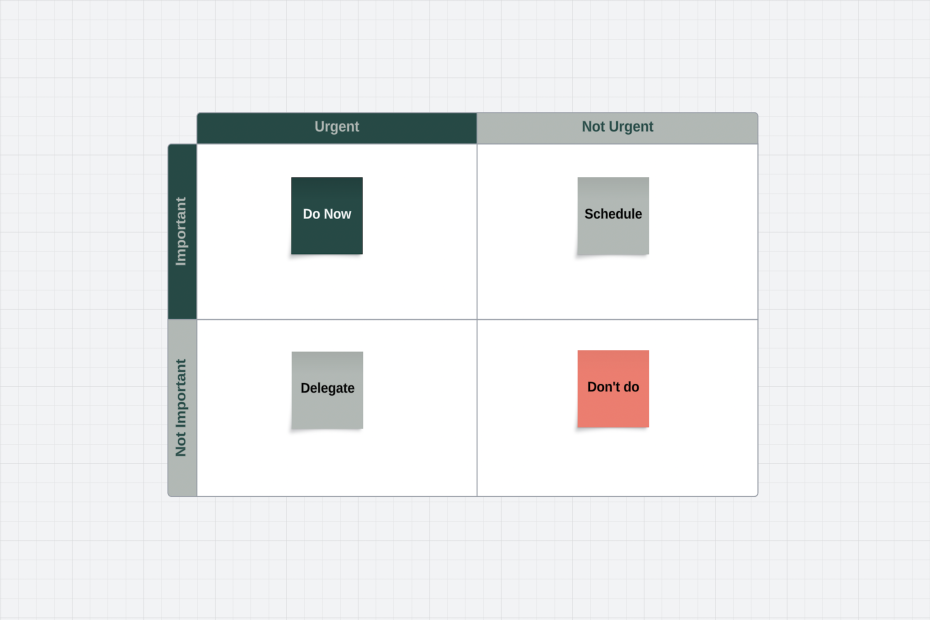
Leaders must possess excellent time management skills to become better decision-makers. I recently came across the Eisenhower matrix, a time management method that helps leaders overcome decision paralysis by sorting tasks across four quadrants. Tasks should be prioritized or deprioritized based on their urgency and importance. The x-axis contains two categories, “Urgent” and “Not Urgent” (left-right). The y-axis contains another set of two, “Important” and “Not Important” (top-bottom).
Do you have an urgent and important task? Do it now. If the task is urgent but not important, try to delegate it to someone else. What if you have a task that’s important, but not urgent? In that case, you should schedule time to complete these tasks. Finally, cross out any items that are neither important nor urgent.
In addition to breaking down each category, we’ll include a business metaphor (hold on—it gets better). In this example let’s say that Amir is a recent MBA grad who’s decided to open up a local ice cream shop so he can finally win over his childhood crush and settle down:
Urgent and Important
Your typical run-of-the-mill fires, emergencies, and time-sensitive, crucial tasks live here. Doing these tasks should be your priority to keep your workstream running smoothly. Another way of thinking about this category is delaying these tasks any longer could be costly. Let’s visit our new small business owner, Amir, to better understand what tasks fall here.
Amir is two weeks into running Saffron Scoop. As he’s getting ready to open his shop, he realizes that his freezer isn’t working. He needs to get his freezer fixed before his inventory completely melts, and with it, his chances of marrying Zayna (his childhood crush). It’s safe to say, that this task would fall under the urgent and important category. Amir springs into action by pulling up YouTube and searching “freezer not working”—22 min go by, and his watch history is filling up with skimmed-through tutorial after tutorial, and yet, he’s no closer to fixing his freezer. Amir finally calls a repairman, and thankfully, his freezer is fixed by 11:08 AM.
Not Urgent and Important
This section contains your important but non-time-sensitive tasks. For example, tasks such as responding to emails, completing paperwork, or up-leveling your knowledge can be scheduled for a specific date and time, perhaps later in the week or month.
Let’s say Amir has received an influx of mostly positive Google reviews in the last two weeks. To build better brand awareness, he understands the importance of replying with personalized responses, perhaps including an emoji or two. However, this is not a priority right now and could distract Amir from his more urgent tasks. Amir realizes that in a week, those reviews will still be there, so he’s better off scheduling a time to thank his patrons (or craft witty responses to his haters) for when things are slow.
Urgent and Not Important
A lot of things will pop up on a daily basis, but not everything that comes up is important. This category mostly consists of busy work. If it can be outsourced (i.e., it doesn’t require your expertise or immediate input), even better.
Instead of answering the phone, bussing tables, or manning the cashier, Amir needs to optimize his business, launch a brand new marketing campaign, and continue creating new flavor combinations. “Will the hot honey gulab jamun provide the marketing buzz I desperately crave?” Amir thinks to himself. This is exactly why he hired his 16-year-old cousin Hasan. While Amir is working on new initiatives that will increase revenue, he can delegate tasks like dealing with customer inquiries to Hasan, who will no doubt be preoccupied with scrolling through NBA Twitter.
Not Urgent and Not Important
Sometimes, our priorities change or we realize that tasks, like habitually checking LinkedIn, were never important to begin with. In addition to mindless activities, this quadrant includes tasks that are not integral at the current phase of a project or business.
For example, Amir may love writing and hosting daily stand-up meetings, but with only one other employee, it’ll be a while before he needs to create an internal newsletter or have daily syncs with his team (Hasan). Amir should scrap these ideas and focus on more pressing matters, like impressing Zayna’s dad.
The Eisenhower matrix is only one time-management method that can help you overcome decision paralysis. There are several other methods, but if you’re looking for a quick and easy way to categorize tasks based on priority, this matrix is a huge step up from a basic to-do list.