(source: Nassef Mohsen Ali)
As far as I can remember, I always wanted to be a photographer. My journey behind the camera started in 2011 in Fresno, CA, when I picked up one of my dad’s old film cameras.
I had just started my sophomore year of high school and yearned for a creative outlet to get engrossed in when I wasn’t playing Call of Duty over Xbox Live. The reachability of film made it a no-brainer. I could get a roll developed, scanned, and printed on 4 x 6 glossy Kodak paper in under an hour for $5 at my local Costco. Plus, with the abundance of 90s point-and-shoot film cameras hiding in my parents’ closets, I wouldn’t need money (I didn’t have) to buy a digital camera.
Film always had a certain charm. I grew accustomed to the warm tones of Kodak film stock (or whatever I could find in my CVS). I immediately fell in love with composing my shots, always challenging myself to find better angles. I could compose and click away with a point-and-shoot. However, it wasn’t until a year later—when I got a vintage Canon AE-1 off of eBay, that I started to appreciate the analog component of shooting film. By adopting this new (older) tool, I was forced to slow down, take my time adjusting my camera settings, and learn the fundamentals of photography.
When I first decided to become a photographer, I never anticipated the other ways photography would benefit me. In retrospect, I’ve realized that photography made me a better problem solver, challenging me to continuously learn more and improve how I approach subjects in my composition.
Overcoming the Technical Challenge
There’s nothing like that first blank roll to really humble a photographer—and I don’t mean leaving the lens cap on. I mean royally messing up your shutter speed, aperture, and ISO settings (exposure triangle) so that every shot comes out blank. Before, I could depend on my camera’s metering to do most of the work, but now I needed to understand the ins and outs of the exposure triangle. As I adjusted one element, like my shutter speed, I needed to compensate by adjusting another.
If I wanted to capture a car moving quickly, a quicker shutter speed like 1/1000 would require adjusting my ISO or aperture. Since I’m shooting on film, my ISO is fixed—in this case, at 100. So, I need to increase my aperture from f/11 to f/4 to compensate for the lower light coming in. I’m shooting at f/4. Fortunately, the car is in focus, but because the aperture is on the shallow side, the background is blurrier than I would like. Next time, I need to load 400 ISO film to have more flexibility in using a smaller aperture to get more details in my shot.
In the summer of 2016, I took a solo day trip to Yosemite (one perk of living in Fresno). I remember waking up at 3:00 am to watch the sunrise from Tunnel View. Though the view alone was worth getting my sleep-deprived self out of bed, it wasn’t unique. It was a postcard image. After spending half the day taking photos, I felt dissatisfied with my inability to capture something unique. At this point, I was dead tired. It was time to call it quits. I remember driving back through Wawona tunnel, when an idea hit me. These tunnel lights weren’t all the same. At about the halfway mark, the lights changed from a blue-greenish hue to orange. As I exited the tunnel, I immediately parked my car to the right, pulled out my tripod, and walked back through the tunnel to where those lights transitioned, carefully ensuring I didn’t get hit by a car.
Once I reached the point where the lights transitioned, I began strategizing how to make my idea a reality. I wanted a long-exposure shot so the cars would leave light trails. With me, I had my Canon AE-1, a cheap plastic tripod, and a light metering app on my phone. Unfortunately, my roll of Kodak Ultramax only had four shots left, and since I didn’t have a shutter release cable, I couldn’t use bulb mode on my camera to control how long my shutter was open. To top it off, since I needed to eliminate any camera shake, I couldn’t manually press my shutter button. With my limitations, I needed to get creative.
I finally came up with a solution. To MacGyver the situation, I would set my shutter speed to two seconds, and since I couldn’t physically press my shutter button (due to camera shake), I would use the built-in self-timer on my camera while it was on the tripod. The self-timer was set to 10 seconds by default, which posed another challenge. I would have to gamble what cars would be in front of me once the shutter released. With four shots left in my role and my best judgment, I fired away.
Of my remaining shots, this one, by far, came the closest to my vision.

Improving My Photographic Eye
Composition is the one photographic element that has always come naturally to me. Even before learning the “rules” of photography, such as the rules of thirds, symmetry, and the golden ratio, the one thing I could count on was my ability to frame a shot. My love of cinematography no doubt played a role in shaping my photographic eye.
My portfolio mainly consisted of one-off shots. Individually, they were great, but my work lacked an underlying theme. I knew if I were to get to the next level, I needed to approach my work more thematically, which meant challenging what my eyes saw or, in this case, overlooking. I constantly ran into the issue of boredom because I couldn’t decide what to photograph. From 2015 to 2018, I averaged three to four rolls of film a year. I was too selective with my shots, constantly asking myself if this photo could be framed on a wall when I should’ve asked if this photo could be a story point as part of a more extensive photo series.
Determined to mature as a photographer, I shot more rolls of film from 2019 to 2021 than from 2011 to 2018. By forcing myself to shoot, I rewired my photographic eye to find beauty in the mundane and become a more potent visual storyteller.
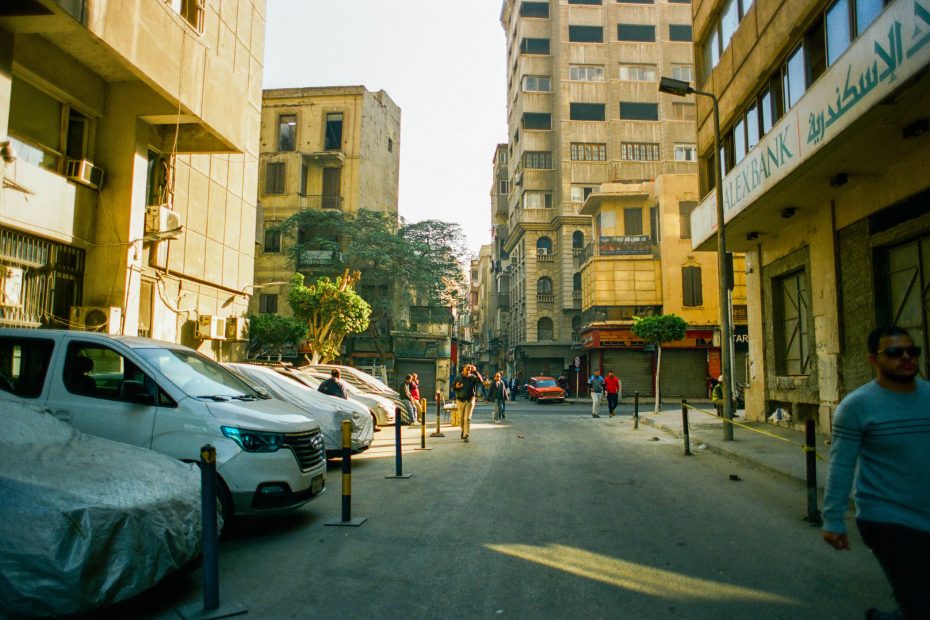
One of my favorite series, “The Streets of Cairo,” was shot in December 2022 during a trip to Egypt. I packed my Canon AE-1 and one roll of film. I had one week to see a photo project from start to finish. As I ventured the lively streets of Cairo, camera in hand, I was constantly looking for photo opportunities.


While I didn’t know it then, my passion for photography would go on to play an essential part in shaping my creative problem-solving abilities. I’m constantly trying to one-up my previous photo series and rewire how I approach photo subjects. So, what hobby keeps you mentally engaged and challenges you to see problems differently?